We run our own company on our own automation
This page shows what runs overnight until one report arrives at 8 a.m. Checking eight sites, reading and judging the results, and bundling them into a single report are all automatic. The only thing a person does is read that report and decide what to do first.
Runs automatically 10 times a day · of six stages, 2 are handled by AI · 1 by a person
It runs ten times a day on its own, and in the morning a person reads one report.
Opening eight sites three times a day, reading the results and picking out what changed, writing an eight-section management report — all of it is gone from human hands. Also here: taking in settlement statements from twenty-six clients and producing the issuance ledger. What used to take one person all day now takes one hour.
One thing remains. Reading the report that arrives at 8 a.m. and deciding what to do first — of the six boxes, that's the only one a person touches. The other five are already done while we sleep.
The same structure we build for clients we hang on our own company first and use every day. There's a reason for that — automation can fail while the screen still looks perfectly fine. When records are kept and lists load but no new data accumulates, no amount of staring at the screen will tell you.
So it's not "was it installed?" — "did it arrive today?" is what we check. Each run leaves one line recording success or failure, and if a run stops, the next morning's report says so first. We put the same structure into the client work we build.
This set was not built to order — we built it for our own use. That's why it isn't mixed in with client cases.
One full loop runs every day.
The systems in this set are not separate jobs, each running at its own time. checking → reading and judging → collecting → sending as one report is one loop, and that loop starts again at the same point every day.
In each box, "the breaking point" is written down alongside it — what would happen to that box if it were not set up this way. What actually happened to us, and the figures from back then, are in the three sections below the loop.
How to read the markers — an empty, angular marker means rules; a filled marker means the judging side.
- Rules Only does what was written down in advance. Same input in, same output out.
- AI Only takes on judgment that can't be written down as a rule
- People Reads the report that arrives and decides what to do first
-
Checks
07:50 · 12:50 · 18:50
Reopens eight sites, up to twelve items each, and picks out only what changed from yesterday
Rules
-
Reads and judges
05:00
Seven agents with different roles read the results and each gives a verdict. Thirty role definitions are kept on hand; seven of them enter this meeting
AI
The breaking point If yesterday's proposals aren't reopened today, a growing list and actual work look exactly the same
The seven that enter this meeting — all AI, with no humans attending
- Search exposure Looks in structure and keywords for where a page is more likely to show up in search results
- Reading the numbers Checks whether yesterday's proposal took effect and where people drop out
- Content Plans what to create next so it matches search queries
- Technical assessment Determines whether it's technically possible and how much work it takes
- Draft Writes up what was confirmed in planning. If nothing is confirmed, nothing gets written
- Review Cross-checks that what the five produced actually exists and that the figures line up
- Consolidation Bundles the five verdicts into a single report and hands it to the morning report
-
Monitors
05–07
Checks progress every 10 minutes
Rules
The breaking point If AI holds both its own schedule and its verdicts, you only learn about progress the way AI tells it
-
Collects
07:30
Collects the meeting results. Completion is judged not by what the meeting said but by values verified today. The collection must finish before the morning report to make it into that day's report
Rules
The breaking point If you take the meeting's word that something was handled, the ledger only stacks up stamps
-
Reports
08:00
It lands in one report — what changed and what to tackle first. Rules decide the figures, the categories, and what goes on top; the only thing AI writes is the single sentence at the top
Rules One sentence from AI
The breaking point If AI is also left to interpret the numbers, the sentences read smoothly and the format is right, but the figures change. No error is ever raised
-
Decides
After the report arrives
Reads the report that arrives and decides what to do first. This is the one place where a person's hand is involved
People
And then it checks again — this is where it returns to the start
Of the six boxes, AI handles two. Checking, watching progress, collecting, and bundling into one report are all done by rules — places where the same input must produce the same output because that is exactly what those places are. AI is used only where a judgment cannot be written as a rule: the pre-dawn meeting's verdict and the single sentence at the top of the morning report. AI does not write the report — rules determine the figures in all eight sections, what counts as complete and what is a recurring item, and what goes on top.
In one loop, the last box is the only one a person touches. Checking, reading and judging, and collecting into one report all run without waiting for a person. We didn't hand over the fixing, either — checking only sends queries and changes nothing. If the side that verifies touches what it verifies, the figures after that cannot be trusted. So what arrives in the morning is not a fixed result but a report that says what to fix.
What a person fixes is picked up as-is by the next round's check. When we added a tag to one site telling search engines who owns it, that line came up in the next check's "changed items" list even though the person who added it never reported it (2026-08-09).
More things running on the same server, outside the loop
- 07:30 Collects and re-verifies client settlement statements
- 09:00 · 15:00 · 21:00 Collects support-program announcements
Adding these three to the loop's seven rounds makes 10 runs a day. The 07:30 run is in the same round as collecting the meeting results and re-verifying the settlement statements.
Every day, we re-verify what AI said it "handled".
AI answers diligently every day. No one tells us what became of that answer. Nothing breaks, and the output keeps coming every day. So it's only after months pile up that we ask, "what did all of this become?"
So, to verify whether proposals were actually processed, a device that stamps them automatically is attached, and the routine that reopens yesterday's items runs every day. Proposals aren't all we verify — the next round even re-checks whether that stamp is correct.
Once a device that automatically stamps "done" is attached, nobody ever re-checks whether the device itself is right. Items marked as processed but with nothing actually reflected get mixed in, and the result is a state where the work is not done but only appears done. Looking only at the ledger, it looks healthier than ever — no errors, no warnings. Even in ours, five out of nine were off, and the routine that reopens yesterday's items caught them in the next round.
-
Yesterday's items are read first, before the meeting opens
Previous proposals and what changed after them go at the very front of the meeting materials. Today's meeting never starts without knowing what was said yesterday.
-
A fixed format is written at the end of the minutes
If only prose is left, there is no way to cross-check it the next day. For each proposal, what to do, by whom, why, and how it will be verified is written in fixed fields.
-
We didn't make a separate scorecard
Proposals, statements, and processing times pile up in the ledger, and results come out of that ledger. A scorecard would bend the work toward raising the score — people do that too, and AI more so. Told to raise the score, it will really only raise the score.
-
The verdict field is filled only when there is a previous proposal
If nothing was put forward yesterday, the field comes empty. Told to fill it, AI invents evidence that doesn't exist. A field that comes empty is more trustworthy than one that was filled.
"Completion is judged only by verified values" is the principle, and the ledger keeps exactly which proposals met that condition. Those that didn't meet it are kept too — so that later, no one can say "we kept everything."
The most recent minutes contain a passage like this, verbatim — about a figure that had gone down, "we didn't read it as success or failure" they wrote, and moved on, citing "no record of the cause." Even about a figure that had gone up, "we didn't call it a search success" they wrote — the reason being that the incoming paths had not yet been split out. We made "I don't know" be written as-is. That way, when things genuinely improve later, the report can be believed.
The meeting on August 23, 2026 was the 12th, with 4 new proposals and 27 verdicts on previous proposals. More than six times as much room went into re-checking yesterday's words as into new proposals. The completion count that round recorded for itself was 0건. With AI blocked from stamping "complete" itself, the completion column comes out 0. That is the honest number. A ledger stamped "12 completed" is less trustworthy than a ledger stamped 0.
The numbers in the management report are decided by rules.
AI writes well, exactly as told. And in that process, numbers change quietly. It prints something like "shortfall: ○○ won," but from the report alone you cannot tell whether that is the amount needed on a particular date or the total for the whole billing cycle.
It actually happened once in our own report. The total was read as the amount needed on a specific date, inflating it to nearly four times the real figure. What we learned here was not "let's use a better model." Unless you separate the place that judges from the place that copies, the same thing happens again no matter what you fix — that was the lesson. We draw that line first, before starting.
-
We classify only by values that actually exist in the data
Whether an item is completed, a recurring item that goes out automatically every month, or a bundle rather than actual work is decided by fields the data already has. So every item in the report can be found as-is in the source data.
-
Even if one lookup fails, the report still goes out
Instead, it writes at the top what it could not see. A single blocked source does not empty the whole morning.
Copied verbatim from the instruction passed to the AI alongside
- Do not create or change numbers or items
- Copy it as-is without changing a single character. Do not summarize, merge, or omit anything
- Do not recalculate amounts, do not invent funding methods, and do not assert that a transfer was made
- Do not add news, market outlooks, or business ideas that are not in the source data
And there is one more line. We consider it the most important sentence in this system.
If a "lookup failed," treat the figure in the section that item fills not as "none" but as "not seen."
"Nothing is going out" and "we could not confirm what goes out" are completely different statements. If the two are written the same way, nobody can tell whether a quiet morning is one you can relax about. For the reader of the report to make that distinction, the maker has to separate them first.
The one sentence we leave the AI is "what should be tackled first today?" The priority criteria are given along with it — work with a fixed external deadline comes first, anything that accrues late fees if delayed goes in the morning, work that brings in cash comes next, and development with no external deadline goes after that. This judgment is hard to write as a rule. Because the answer changes depending on what overlaps on any given day.
You can tell whether a quiet morning is one you can relax about.
A check can only speak when it has actually run. So on a morning when the server was completely down, every check stays quiet. No warnings appear, and both the dashboard and the report look peaceful. There was actually a day when six morning hours were missing entirely — every job that should have run in that window was skipped, yet not a single section said anything was wrong.
When "no alert arrived" and "there was nothing to alert" look the same, that is the blind spot a company with automated checks discovers last.
-
We separately count how many scheduled runs remain in each time slot
This shows whether a time slot has effectively stopped, independent of the individual checks. When a value cannot be read, it is marked "not read," not 0.
-
The report states inside itself what it cannot see
This one line is appended to the end of that section.
This section cannot see the failure of the 08:00 report itself. A day with no report at all is that signal.
So for your company, "the morning report did not arrive" is itself the biggest warning. As long as the reader knows that one line, a quiet morning will never be misread.
What we use every day.
The first slot of the loop and the 07:30 one outside the loop each get their own entry. What went wrong and how we verify it now are written there. Since this is an internal system, there is no address to open. Instead, actual screenshots with client names and amounts masked and the figures the tool produced itself.
-
Cut tax invoice issuance from a full day for one person to one hour
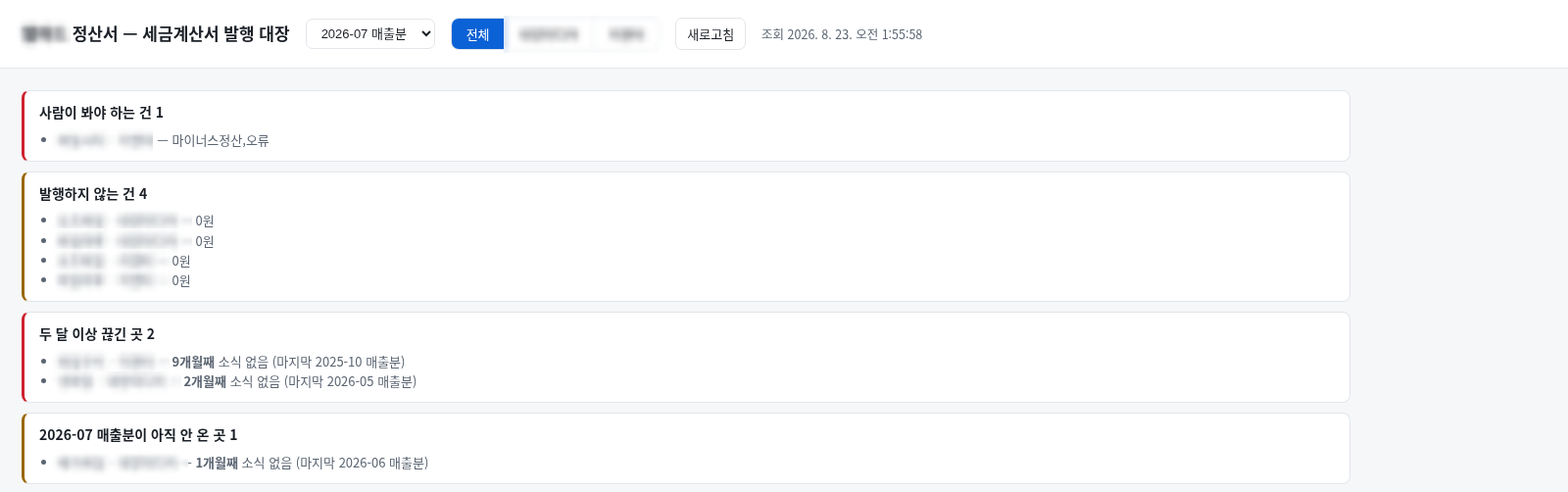
Every morning, it reads the settlement ledgers that 26 vendors send by email on its own and builds the register of who should be invoiced and for how much. Opening each email, downloading attachments, and transcribing amounts by hand are gone — the only human step left is pressing the issue button.
From checking settlement ledgers to the tax invoice issuance register One person all day from 1 hour to
-
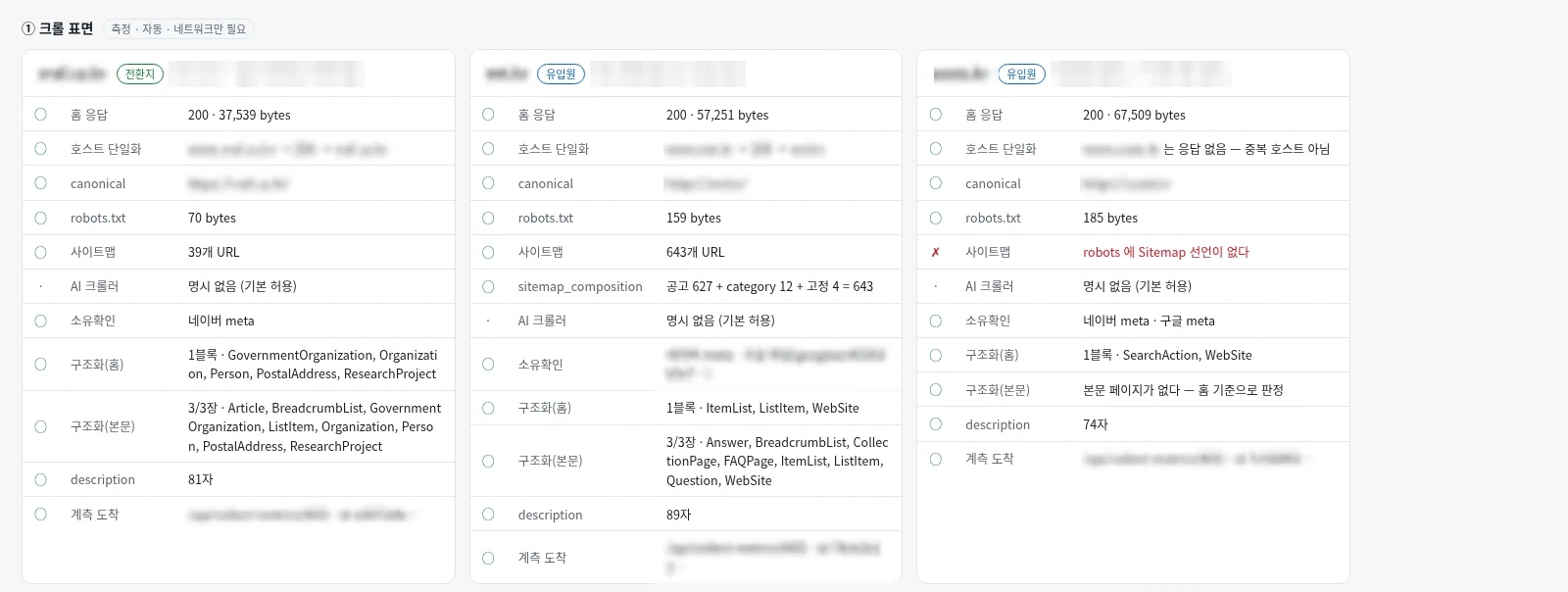
Checks eight sites three times a day to see whether search engines can read them
Checks up to twelve items per site and reports only the results that changed from yesterday. Cut required-item failures from 24 to 16, and the remaining 16 are tallied by a tool, not a person.
Readable by search engines — unmet items 24 items (2026-08-12) from 16 items (2026-08-23) to
The same structure can be applied to your numbers.
Every morning you receive the numbers scattered across your systems as a single letter — warehouse stock, receivables, yesterday's sales, automations that should have run overnight — What you gather differs, but the structure is the same.
If you have had the AI do work before, you have already seen suggestions pile up with nothing happening. What we build for you is not a place that produces more suggestions but a place that reopens yesterday's suggestion today. Whether you have five fields or ten, it can be built in the same structure, and you will stop receiving reports that surface only the numbers that look good.
And numbers the AI invented never get mixed into management decisions. Because rules decide every figure, classification, and selection. We do not build reports that cannot answer the question "where did this number come from?"
We do not sell this as-is.
What is here is an internal tool built around our own circumstances, so it is not delivered as-is. What we sell is Own products on that side, and this collection serves as evidence that the same approach is applied to other people's work.
If you want to look by technical field: the side that gathers data is Web data collection, the side that aggregates what was gathered by a common standard is Data analysis, and the judgment that cannot be written as rules is AI adoption.
Something of yours may have stopped without you knowing.
If you have an automation you believe is still running, we will first check together when new data last came in.
Replies within 1 business day