

Job-posting collection and publishing tool
Job postings spread across many boards are collected automatically and published to the client's own site under set categories. The screen records how many postings came from each board.
Posting aggregation
Before
Staff checked 19 boards by hand
After
All 318 postings found were collected
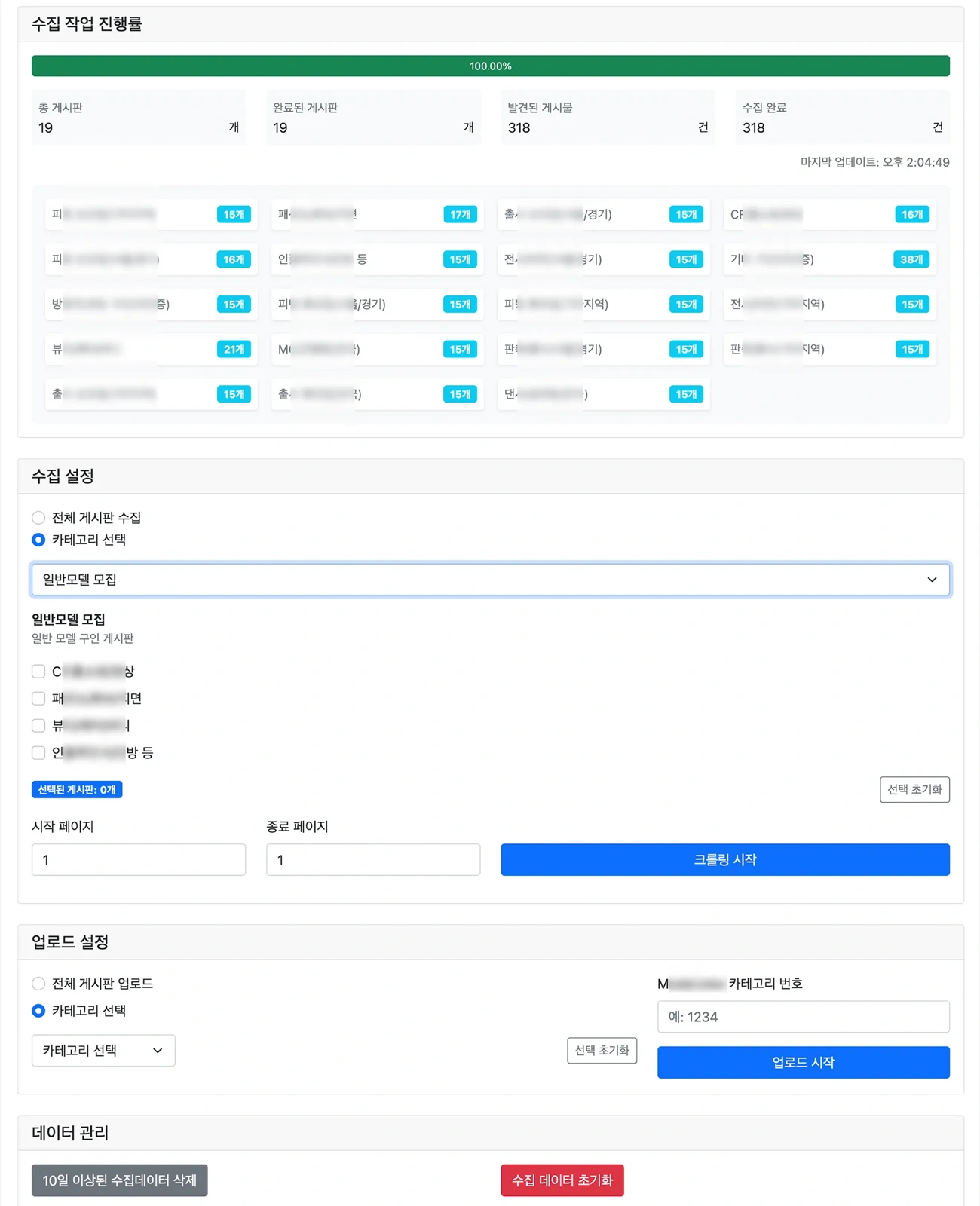
To protect client information, these screens recreate the same features with mock data.
Background
Similar job postings appear separately on many boards. Seeing what was posted where means opening each board in turn, which with nineteen boards means nineteen checks. New postings keep coming, so the work never stops.
What we found
The bigger issue than the repetition was that a missed board goes unnoticed. If someone checking nineteen boards skips one, nothing records that it was skipped. That day’s postings on that board are simply lost.
The problem
Collecting is only half the job. If it is not also decided where each posting goes, staff have to sort everything again, and the manual work has only moved elsewhere. The scope covered linking collection and upload on one screen and making any gaps visible.
What we built
- Collection by board — Scan every board or only selected categories. Set start and end pages to collect only the range needed
- Four separate counts — Total boards, completed boards, postings found, and postings collected are counted separately. A single progress figure cannot show where something was missed
- Counts by board — The screen lists how many postings came from each board. If a number looks unusual, only that board needs another look
- Upload by category — Collected postings are published under the chosen categories, either all at once or category by category
- Old data cleanup — Collected data older than ten days is deleted. Stored data slows the system down, and keeping records that are no longer used is a burden
Results
The tool was built and delivered in about two weeks. A single run scans all 19 boards, collects every one of the 318 postings found, and publishes them under the set categories.
Related work is listed under Web data collection.