

Unauthorized brand seller tracker
For a public cultural foundation's copyright and trademark protection work, we automatically collected the online stores selling products under the foundation's brand name. Results are counted by seller, not by product.
Seller identification
Before
Search results checked one by one
After
All pages collected automatically
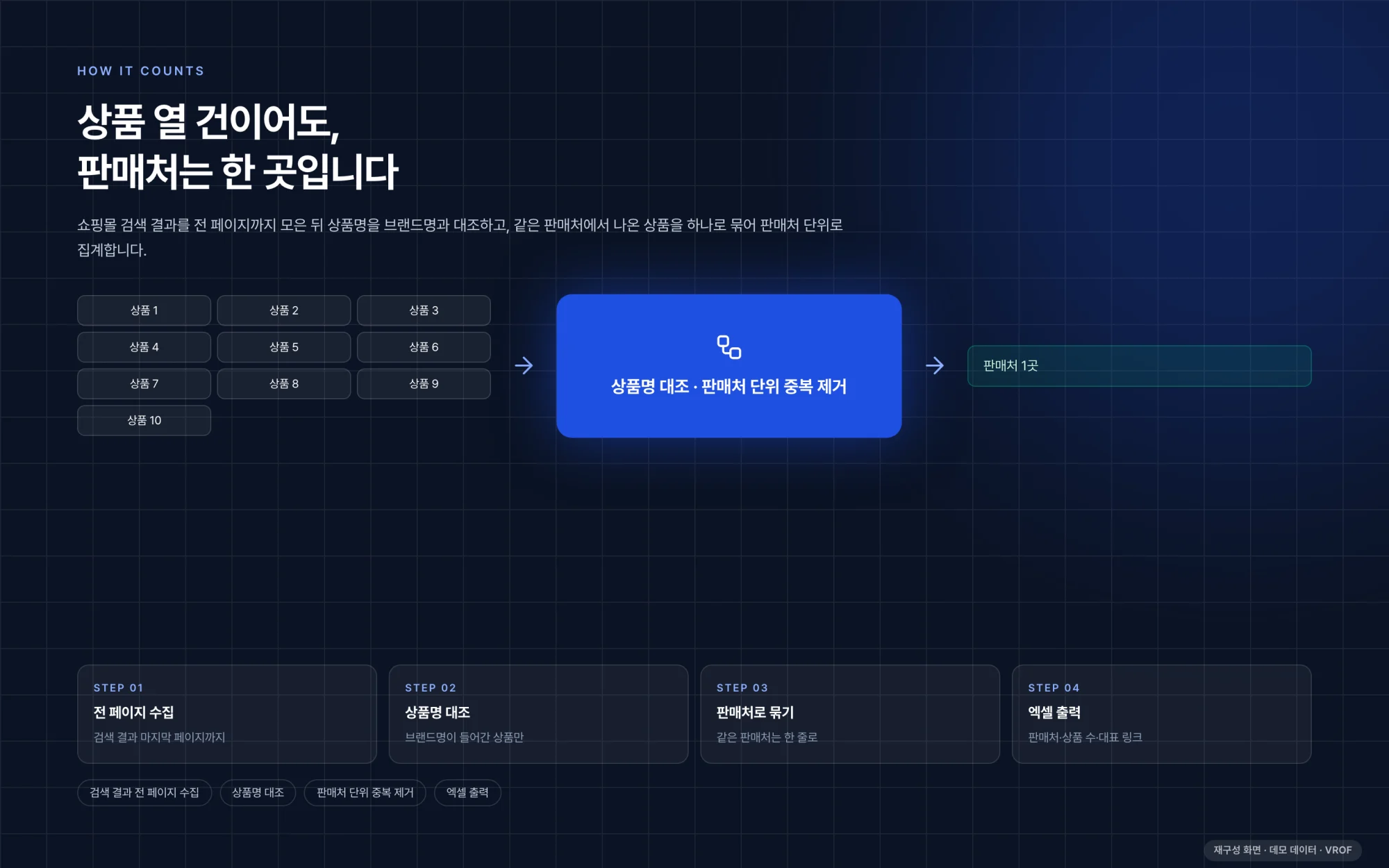
To protect client information, these screens recreate the same features with mock data.
Background
The foundation’s cultural products carry its brand. Products bearing that brand name without authorization appear on online marketplaces. Protecting copyright and trademarks starts with knowing where those products are sold.
What we found
Marketplace search results are split into pages, and the same seller appears again and again with different products. Manual review misses more as it goes deeper into the results, and sellers already checked get checked again. The quality of the review depended on how many pages the results ran to.
The problem
What needed to be found was sellers, not products. Counting by product records the same seller many times, so there is no way to tell how many sellers actually require action. Changing the counting unit was the core of this project.
What we built
- Every results page — The tool searches by brand name and pages through all results, 40 per page
- Product name matching — Only listings whose names actually contain the brand name are kept
- Deduplication by seller — Each seller is recorded once, so the number of cases requiring action equals the number of sellers
- Excel export — Product name, store URL, and position in the search results are recorded so each listing can be found again
Safeguards
- Paced page requests — A random wait is added before each new page. Steady pacing keeps the session from being cut off before the last pages
- Through to the last page — Unauthorized sellers tend to cluster toward the end of the results, not the beginning. Checking only the first few pages misses what needs to be found
- Deduplication at seller level — A seller listing ten products is recorded once, so the number of cases requiring action is not inflated
Results
The full scope of work was completed and delivered.
Related work is listed under Web data collection.